admin
admin 
Peradresavimai yra būtini kiekvienos svetainės priežiūrai, o peradresavimo valdymas tampa tikrai sudėtingas, kai SEO privalumai susiduria su svetainėmis, kuriose yra milijonai puslapių.
Situacijų pavyzdžiai, kai jums gali tekti įgyvendinti peradresavimus mastu:
- El. Prekybos svetainėje yra daugybė produktų, kurie nebe parduodami.
- Pasenę naujienų publikacijų puslapiai nebėra aktualūs arba neturi istorinės vertės.
- Įrašų katalogai, kuriuose yra pasenusių sąrašų.
- Darbo lentos, kuriose baigiasi pranešimai.
Kodėl peradresavimas mastu yra būtinas?
Tai gali padėti pagerinti vartotojo patirtį, konsoliduoti reitingą ir išsaugoti nuskaitymo biudžetą.
Galite apsvarstyti „Noindexing“, tačiau tai netrukdo „GoogleBot“ nuskaityti. Augant puslapių skaičiui, jis eikvoja biudžetą.
Žvelgiant iš vartotojo patirties perspektyvos, nusileidimas pasenusią nuorodą yra nelinksma. Pvz., Jei vartotojas nusileidžia pasenusiam darbo sąrašui, geriau nusiųsti juos į artimiausias mačą aktyviam darbo sąrašui.
„Search Engine Journal“ iš Haliucinacijų gauname daug 404 nuorodų iš AI pokalbių programų, nes jie sugalvoja URL, kurių niekada nebuvo.
Mes naudojame „Google Analytics 4“ ir „Google“ paieškos konsolės (o kartais ir serverio žurnalų) ataskaitas, kad gautume tuos 404 puslapius ir nukreiptume juos į artimiausią atitinkamą turinį, pagrįstą „Straipsnio SLUG“.
Kai „ChatBots“ cituoja mus 404 puslapiais, o žmonės nuolat eina per sugedusias nuorodas, tai nėra gera vartotojo patirtis.
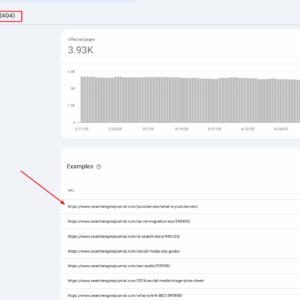
404 URLS ataskaita GSC, 2025 m. Gegužės mėn
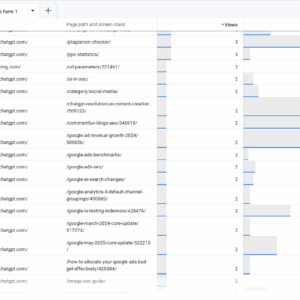
404 Apsilankymai iš „AI Chatbots“, 2025 m. Gegužės mėn
Paruoškite peradresavimo kandidatus
Visų pirma, skaitykite šį įrašą, kad sužinotumėte, kaip sukurti „Pinecone Vector“ duomenų bazę. (Atminkite, kad tokiu atveju mes naudojome „pirminę_kategoriją“ kaip metaduomenų raktą prieš „kategoriją“.)
Norėdami atlikti šį darbą, darome prielaidą, kad visi jūsų straipsnių vektoriai jau yra saugomi duomenų bazėje „INDEX-VERTEX“.
Paruoškite peradresavimo URL CSV formatu, kaip šiame pavyzdžio faile. Tai gali būti esami straipsniai, kuriuos nusprendėte genėti ar 404 iš savo paieškos konsolės ataskaitų arba GA4.
 Imties failo su URL, kad būtų galima nukreipti (ekrano kopija iš „Google“ lapo, 2025 m. Gegužės mėn.)
Pasirenkama „pirminės_kategorijos“ informacija yra metaduomenys, egzistuojantys su jūsų straipsnių „Pinecone“ įrašais, kai juos sukūrėte ir galite būti naudojami filtruoti tos pačios kategorijos straipsnius, dar labiau padidindami tikslumą.
Jei pavadinimo trūksta, pavyzdžiui, 404 URL, scenarijus iš URL ištrauks SLUG žodžius ir panaudos juos kaip įvestį.
Generkite peradresavimus naudodami „Google Vertex AI“
Atsisiųskite savo „Google API“ paslaugos kredencialus ir pervardykite juos kaip „config.json“, įkelkite žemiau esantį scenarijų ir pavyzdinį failą į tą patį katalogą „Jupyter Lab“ ir paleiskite jį.
import os
import time
import logging
from urllib.parse import urlparse
import re
import pandas as pd
from pandas.errors import EmptyDataError
from typing import Optional, List, Dict, Any

from google.auth import load_credentials_from_file
from google.cloud import aiplatform
from google.api_core.exceptions import GoogleAPIError

from pinecone import Pinecone, PineconeException
from vertexai.language_models import TextEmbeddingModel, TextEmbeddingInput

# Import tenacity for retry mechanism. Tenacity provides a decorator to add retry logic
# to functions, making them more robust against transient errors like network issues or API rate limits.
from tenacity import retry, wait_exponential, stop_after_attempt, retry_if_exception_type

# For clearing output in Jupyter (optional, keep if running in Jupyter).
# This is useful for interactive environments to show progress without cluttering the output.
from IPython.display import clear_output

# ─── USER CONFIGURATION ───────────────────────────────────────────────────────
# Define configurable parameters for the script. These can be easily adjusted
# without modifying the core logic.

INPUT_CSV = "redirect_candidates.csv"      # Path to the input CSV file containing URLs to be redirected.
                                           # Expected columns: "URL", "Title", "primary_category".
OUTPUT_CSV = "redirect_map.csv"            # Path to the output CSV file where the generated redirect map will be saved.
PINECONE_API_KEY = "YOUR_PINECONE_KEY"     # Your API key for Pinecone. Replace with your actual key.
PINECONE_INDEX_NAME = "article-index-vertex" # The name of the Pinecone index where article vectors are stored.
GOOGLE_CRED_PATH = "config.json"           # Path to your Google Cloud service account credentials JSON file.
EMBEDDING_MODEL_ID = "text-embedding-005"  # Identifier for the Vertex AI text embedding model to use.
TASK_TYPE = "RETRIEVAL_QUERY"              # The task type for the embedding model. Try with RETRIEVAL_DOCUMENT vs RETRIEVAL_QUERY to see the difference.
                                           # This influences how the embedding vector is generated for optimal retrieval.
CANDIDATE_FETCH_COUNT = 3    # Number of potential redirect candidates to fetch from Pinecone for each input URL.
TEST_MODE = True             # If True, the script will process only a small subset of the input data (MAX_TEST_ROWS).
                             # Useful for testing and debugging.
MAX_TEST_ROWS = 5            # Maximum number of rows to process when TEST_MODE is True.
QUERY_DELAY = 0.2            # Delay in seconds between successive API queries (to avoid hitting rate limits).
PUBLISH_YEAR_FILTER: List(int) = ()  # Optional: List of years to filter Pinecone results by 'publish_year' metadata.
                                     # If empty, no year filtering is applied.
LOG_BATCH_SIZE = 5           # Number of URLs to process before flushing the results to the output CSV.
                             # This helps in saving progress incrementally and managing memory.
MIN_SLUG_LENGTH = 3          # Minimum length for a URL slug segment to be considered meaningful for embedding.
                             # Shorter segments might be noise or less descriptive.

# Retry configuration for API calls (Vertex AI and Pinecone).
# These parameters control how the `tenacity` library retries failed API requests.
MAX_RETRIES = 5              # Maximum number of times to retry an API call before giving up.
INITIAL_RETRY_DELAY = 1      # Initial delay in seconds before the first retry.
                             # Subsequent retries will have exponentially increasing delays.

# ─── SETUP LOGGING ─────────────────────────────────────────────────────────────
# Configure the logging system to output informational messages to the console.
logging.basicConfig(
    level=logging.INFO,  # Set the logging level to INFO, meaning INFO, WARNING, ERROR, CRITICAL messages will be shown.
    format="%(asctime)s %(levelname)s %(message)s" # Define the format of log messages (timestamp, level, message).
)

# ─── INITIALIZE GOOGLE VERTEX AI ───────────────────────────────────────────────
# Set the GOOGLE_APPLICATION_CREDENTIALS environment variable to point to the
# service account key file. This allows the Google Cloud client libraries to
# authenticate automatically.
os.environ("GOOGLE_APPLICATION_CREDENTIALS") = GOOGLE_CRED_PATH
try:
    # Load credentials from the specified JSON file.
    credentials, project_id = load_credentials_from_file(GOOGLE_CRED_PATH)
    # Initialize the Vertex AI client with the project ID and credentials.
    # The location "us-central1" is specified for the AI Platform services.
    aiplatform.init(project=project_id, credentials=credentials, location="us-central1")
    logging.info("Vertex AI initialized.")
except Exception as e:
    # Log an error if Vertex AI initialization fails and re-raise the exception
    # to stop script execution, as it's a critical dependency.
    logging.error(f"Failed to initialize Vertex AI: {e}")
    raise

# Initialize the embedding model once globally.
# This is a crucial optimization for "Resource Management for Embedding Model".
# Loading the model takes time and resources; doing it once avoids repeated loading
# for every URL processed, significantly improving performance.
try:
    GLOBAL_EMBEDDING_MODEL = TextEmbeddingModel.from_pretrained(EMBEDDING_MODEL_ID)
    logging.info(f"Text Embedding Model '{EMBEDDING_MODEL_ID}' loaded.")
except Exception as e:
    # Log an error if the embedding model fails to load and re-raise.
    # The script cannot proceed without the embedding model.
    logging.error(f"Failed to load Text Embedding Model: {e}")
    raise

# ─── INITIALIZE PINECONE ──────────────────────────────────────────────────────
# Initialize the Pinecone client and connect to the specified index.
try:
    pinecone = Pinecone(api_key=PINECONE_API_KEY)
    index = pinecone.Index(PINECONE_INDEX_NAME)
    logging.info(f"Connected to Pinecone index '{PINECONE_INDEX_NAME}'.")
except PineconeException as e:
    # Log an error if Pinecone initialization fails and re-raise.
    # Pinecone is a critical dependency for finding redirect candidates.
    logging.error(f"Pinecone init error: {e}")
    raise

# ─── HELPERS ───────────────────────────────────────────────────────────────────
def canonical_url(url: str) -> str:
    """
    Converts a given URL into its canonical form by:
    1. Stripping query strings (e.g., `?param=value`) and URL fragments (e.g., `#section`).
    2. Handling URL-encoded fragment markers (`%23`).
    3. Preserving the trailing slash if it was present in the original URL's path.
       This ensures consistency with the original site's URL structure.

    Args:
        url (str): The input URL.

    Returns:
        str: The canonicalized URL.
    """
    # Remove query parameters and URL fragments.
    temp = url.split('?', 1)(0).split('#', 1)(0)
    # Check for URL-encoded fragment markers and remove them.
    enc_idx = temp.lower().find('%23')
    if enc_idx != -1:
        temp = temp(:enc_idx)
    # Determine if the original URL path ended with a trailing slash.
    has_slash = urlparse(temp).path.endswith('/')
    # Remove any trailing slash temporarily for consistent processing.
    temp = temp.rstrip('/')
    # Re-add the trailing slash if it was originally present.
    return temp + ('/' if has_slash else '')


def slug_from_url(url: str) -> str:
    """
    Extracts and joins meaningful, non-numeric path segments from a canonical URL
    to form a "slug" string. This slug can be used as text for embedding when
    a URL's title is not available.

    Args:
        url (str): The input URL.

    Returns:
        str: A hyphen-separated string of relevant slug parts.
    """
    clean = canonical_url(url) # Get the canonical version of the URL.
    path = urlparse(clean).path # Extract the path component of the URL.
    segments = (seg for seg in path.split('/') if seg) # Split path into segments and remove empty ones.

    # Filter segments based on criteria:
    # - Not purely numeric (e.g., '123' is excluded).
    # - Length is greater than or equal to MIN_SLUG_LENGTH.
    # - Contains at least one alphanumeric character (to exclude purely special character segments).
    parts = (seg for seg in segments
             if not seg.isdigit()
             and len(seg) >= MIN_SLUG_LENGTH
             and re.search(r'(A-Za-z0-9)', seg))
    return '-'.join(parts) # Join the filtered parts with hyphens.

# ─── EMBEDDING GENERATION FUNCTION ─────────────────────────────────────────────
# Apply retry mechanism for GoogleAPIError. This makes the embedding generation
# more resilient to transient issues like network problems or Vertex AI rate limits.
@retry(
    wait=wait_exponential(multiplier=INITIAL_RETRY_DELAY, min=1, max=10), # Exponential backoff for retries.
    stop=stop_after_attempt(MAX_RETRIES), # Stop retrying after a maximum number of attempts.
    retry=retry_if_exception_type(GoogleAPIError), # Only retry if a GoogleAPIError occurs.
    reraise=True # Re-raise the exception if all retries fail, allowing the calling function to handle it.
)
def generate_embedding(text: str) -> Optional(List(float)):
    """
    Generates a vector embedding for the given text using the globally initialized
    Vertex AI Text Embedding Model. Includes retry logic for API calls.

    Args:
        text (str): The input text (e.g., URL title or slug) to embed.

    Returns:
        Optional(List(float)): A list of floats representing the embedding vector,
                               or None if the input text is empty/whitespace or
                               if an unexpected error occurs after retries.
    """
    if not text or not text.strip():
        # If the text is empty or only whitespace, no embedding can be generated.
        return None
    try:
        # Use the globally initialized model to get embeddings.
        # This is the "Resource Management for Embedding Model" optimization.
        inp = TextEmbeddingInput(text, task_type=TASK_TYPE)
        vectors = GLOBAL_EMBEDDING_MODEL.get_embeddings((inp), output_dimensionality=768)
        return vectors(0).values # Return the embedding vector (list of floats).
    except GoogleAPIError as e:
        # Log a warning if a GoogleAPIError occurs, then re-raise to trigger the `tenacity` retry mechanism.
        logging.warning(f"Vertex AI error during embedding generation (retrying): {e}")
        raise # The `reraise=True` in the decorator will catch this and retry.
    except Exception as e:
        # Catch any other unexpected exceptions during embedding generation.
        logging.error(f"Unexpected error generating embedding: {e}")
        return None # Return None for non-retryable or final failed attempts.

# ─── MAIN PROCESSING FUNCTION ─────────────────────────────────────────────────
def build_redirect_map(
    input_csv: str,
    output_csv: str,
    fetch_count: int,
    test_mode: bool
):
    """
    Builds a redirect map by processing URLs from an input CSV, generating
    embeddings, querying Pinecone for similar articles, and identifying
    suitable redirect candidates.

    Args:
        input_csv (str): Path to the input CSV file.
        output_csv (str): Path to the output CSV file for the redirect map.
        fetch_count (int): Number of candidates to fetch from Pinecone.
        test_mode (bool): If True, process only a limited number of rows.
    """
    # Read the input CSV file into a Pandas DataFrame.
    df = pd.read_csv(input_csv)
    required = {"URL", "Title", "primary_category"}
    # Validate that all required columns are present in the DataFrame.
    if not required.issubset(df.columns):
        raise ValueError(f"Input CSV must have columns: {required}")

    # Create a set of canonicalized input URLs for efficient lookup.
    # This is used to prevent an input URL from redirecting to itself or another input URL,
    # which could create redirect loops or redirect to a page that is also being redirected.
    input_urls = set(df("URL").map(canonical_url))

    start_idx = 0
    # Implement resume functionality: if the output CSV already exists,
    # try to find the last processed URL and resume from the next row.
    if os.path.exists(output_csv):
        try:
            prev = pd.read_csv(output_csv)
        except EmptyDataError:
            # Handle case where the output CSV exists but is empty.
            prev = pd.DataFrame()
        if not prev.empty:
            # Get the last URL that was processed and written to the output file.
            last = prev("URL").iloc(-1)
            # Find the index of this last URL in the original input DataFrame.
            idxs = df.index(df("URL").map(canonical_url) == last).tolist()
            if idxs:
                # Set the starting index for processing to the row after the last processed URL.
                start_idx = idxs(0) + 1
                logging.info(f"Resuming from row {start_idx} after {last}.")

    # Determine the range of rows to process based on test_mode.
    if test_mode:
        end_idx = min(start_idx + MAX_TEST_ROWS, len(df))
        df_proc = df.iloc(start_idx:end_idx) # Select a slice of the DataFrame for testing.
        logging.info(f"Test mode: processing rows {start_idx} to {end_idx-1}.")
    else:
        df_proc = df.iloc(start_idx:) # Process all remaining rows.
        logging.info(f"Processing rows {start_idx} to {len(df)-1}.")

    total = len(df_proc) # Total number of URLs to process in this run.
    processed = 0        # Counter for successfully processed URLs.
    batch: List(Dict(str, Any)) = () # List to store results before flushing to CSV.

    # Iterate over each row (URL) in the DataFrame slice to be processed.
    for _, row in df_proc.iterrows():
        raw_url = row("URL") # Original URL from the input CSV.
        url = canonical_url(raw_url) # Canonicalized version of the URL.
        # Get title and category, handling potential missing values by defaulting to empty strings.
        title = row("Title") if isinstance(row("Title"), str) else ""
        category = row("primary_category") if isinstance(row("primary_category"), str) else ""

        # Determine the text to use for generating the embedding.
        # Prioritize the 'Title' if available, otherwise use a slug derived from the URL.
        if title.strip():
            text = title
        else:
            slug = slug_from_url(raw_url)
            if not slug:
                # If no meaningful slug can be extracted, skip this URL.
                logging.info(f"Skipping {raw_url}: insufficient slug context for embedding.")
                continue
            text = slug.replace('-', ' ') # Prepare slug for embedding by replacing hyphens with spaces.

        # Attempt to generate the embedding for the chosen text.
        # This call is wrapped in a try-except block to catch final failures after retries.
        try:
            embedding = generate_embedding(text)
        except GoogleAPIError as e:
            # If embedding generation fails even after retries, log the error and skip this URL.
            logging.error(f"Failed to generate embedding for {raw_url} after {MAX_RETRIES} retries: {e}")
            continue # Move to the next URL.

        if not embedding:
            # If `generate_embedding` returned None (e.g., empty text or unexpected error), skip.
            logging.info(f"Skipping {raw_url}: no embedding generated.")
            continue

        # Build metadata filter for Pinecone query.
        # This helps narrow down search results to more relevant candidates (e.g., by category or publish year).
        filt: Dict(str, Any) = {}
        if category:
            # Split category string by comma and strip whitespace for multiple categories.
            cats = (c.strip() for c in category.split(",") if c.strip())
            if cats:
                filt("primary_category") = {"$in": cats} # Filter by categories present in Pinecone metadata.
        if PUBLISH_YEAR_FILTER:
            filt("publish_year") = {"$in": PUBLISH_YEAR_FILTER} # Filter by specified publish years.
        filt("id") = {"$ne": url} # Exclude the current URL itself from the search results to prevent self-redirects.

        # Define a nested function for Pinecone query with retry mechanism.
        # This ensures that Pinecone queries are also robust against transient errors.
        @retry(
            wait=wait_exponential(multiplier=INITIAL_RETRY_DELAY, min=1, max=10),
            stop=stop_after_attempt(MAX_RETRIES),
            retry=retry_if_exception_type(PineconeException), # Only retry if a PineconeException occurs.
            reraise=True # Re-raise the exception if all retries fail.
        )
        def query_pinecone_with_retry(embedding_vector, top_k_count, pinecone_filter):
            """
            Performs a Pinecone index query with retry logic.
            """
            return index.query(
                vector=embedding_vector,
                top_k=top_k_count,
                include_values=False, # We don't need the actual vector values in the response.
                include_metadata=False, # We don't need the metadata in the response for this logic.
                filter=pinecone_filter # Apply the constructed metadata filter.
            )

        # Attempt to query Pinecone for redirect candidates.
        try:
            res = query_pinecone_with_retry(embedding, fetch_count, filt)
        except PineconeException as e:
            # If Pinecone query fails after retries, log the error and skip this URL.
            logging.error(f"Failed to query Pinecone for {raw_url} after {MAX_RETRIES} retries: {e}")
            continue # Move to the next URL.

        candidate = None # Initialize redirect candidate to None.
        score = None     # Initialize relevance score to None.

        # Iterate through the Pinecone query results (matches) to find a suitable candidate.
        for m in res.get("matches", ()):
            cid = m.get("id") # Get the ID (URL) of the matched document in Pinecone.
            # A candidate is suitable if:
            # 1. It exists (cid is not None).
            # 2. It's not the original URL itself (to prevent self-redirects).
            # 3. It's not another URL from the input_urls set (to prevent redirecting to a page that's also being redirected).
            if cid and cid != url and cid not in input_urls:
                candidate = cid # Assign the first valid candidate found.
                score = m.get("score") # Get the relevance score of this candidate.
                break # Stop after finding the first suitable candidate (Pinecone returns by relevance).

        # Append the results for the current URL to the batch.
        batch.append({"URL": url, "Redirect Candidate": candidate, "Relevance Score": score})
        processed += 1 # Increment the counter for processed URLs.
        msg = f"Mapped {url} → {candidate}"
        if score is not None:
            msg += f" ({score:.4f})" # Add score to log message if available.
        logging.info(msg) # Log the mapping result.

        # Periodically flush the batch results to the output CSV.
        if processed % LOG_BATCH_SIZE == 0:
            out_df = pd.DataFrame(batch) # Convert the current batch to a DataFrame.
            # Determine file mode: 'a' (append) if file exists, 'w' (write) if new.
            mode="a" if os.path.exists(output_csv) else 'w'
            # Determine if header should be written (only for new files).
            header = not os.path.exists(output_csv)
            # Write the batch to the CSV.
            out_df.to_csv(output_csv, mode=mode, header=header, index=False)
            batch.clear() # Clear the batch after writing to free memory.
            if not test_mode:
                # clear_output(wait=True) # Uncomment if running in Jupyter and want to clear output
                clear_output(wait=True)
                print(f"Progress: {processed} / {total}") # Print progress update.

        time.sleep(QUERY_DELAY) # Pause for a short delay to avoid overwhelming APIs.

    # After the loop, write any remaining items in the batch to the output CSV.
    if batch:
        out_df = pd.DataFrame(batch)
        mode="a" if os.path.exists(output_csv) else 'w'
        header = not os.path.exists(output_csv)
        out_df.to_csv(output_csv, mode=mode, header=header, index=False)

    logging.info(f"Completed. Total processed: {processed}") # Log completion message.

if __name__ == "__main__":
    # This block ensures that build_redirect_map is called only when the script is executed directly.
    # It passes the user-defined configuration parameters to the main function.
    build_redirect_map(INPUT_CSV, OUTPUT_CSV, CANDIDATE_FETCH_COUNT, TEST_MODE)
Pamatysite bandymo paleidimą tik su penkiais įrašais, ir pamatysite naują failą, pavadintą „Direct_map.csv“, kuriame pateikiami peradresavimo pasiūlymai.
Kai užtikrinsite, kad kodas veikia sklandžiai, galite nustatyti TEST_MODE Boolean to True False Ir paleiskite visų jūsų URL scenarijų.
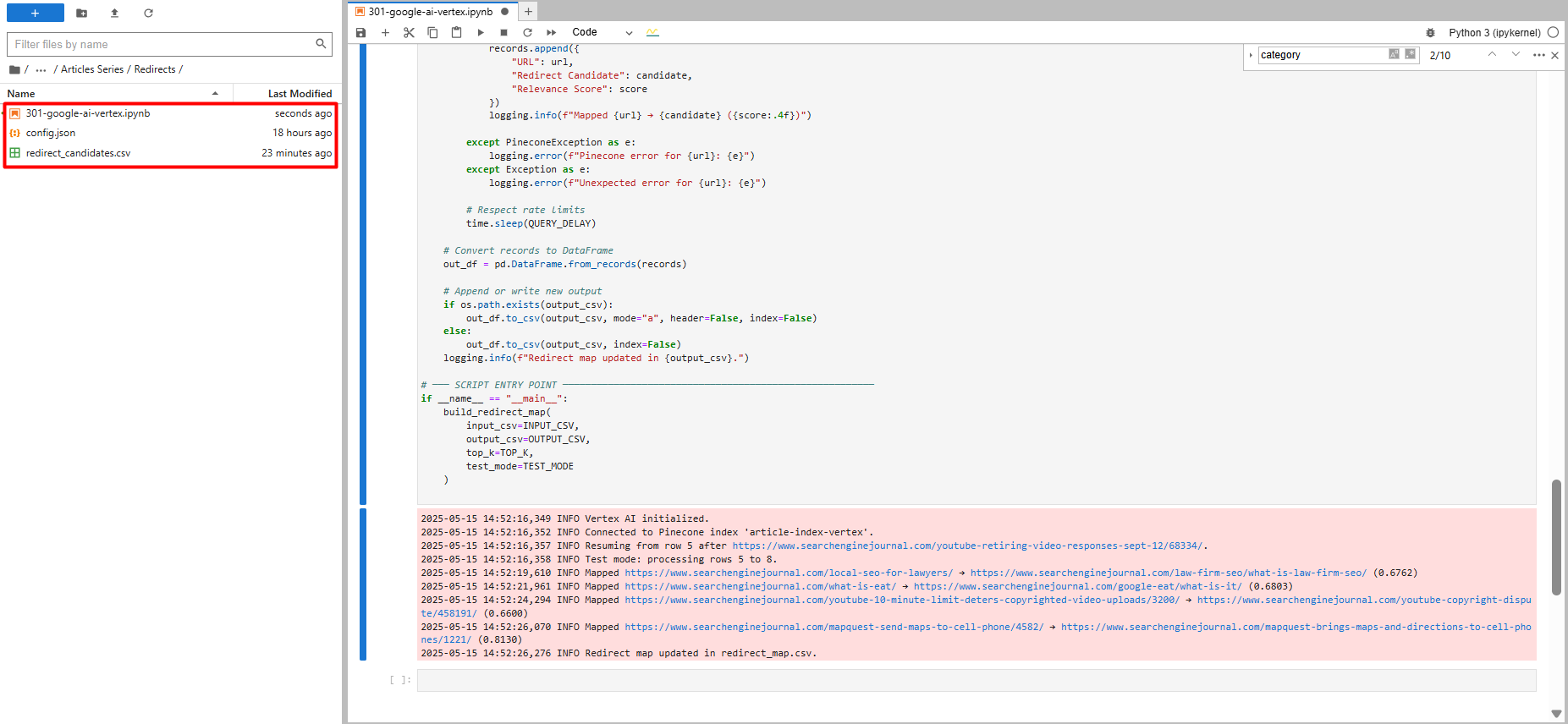 Testo važiavimas tik su penkiais įrašais (vaizdas iš autoriaus, 2025 m. Gegužės mėn.)
Jei kodas sustoja ir atnaujinate, jis pasirinks ten, kur jis baigėsi. Jis taip pat patikrina kiekvieną peradresavimą, kurį jis randa pagal CSV failą.
Šis čekis neleidžia pasirinkti duomenų bazės URL pagal genimų sąrašą. Pasirinkus tokį URL gali sukelti begalinę peradresavimo kilpą.
Mūsų pavyzdžio URL išvestis parodyta žemiau.
 Peradresuokite kandidatus, naudodami „Google Vertex AI“ užduoties tipą Retrietur_Query (vaizdas iš autoriaus, 2025 m. Gegužės mėn.)
Dabar galime paimti šį peradresavimo žemėlapį ir importuoti jį į savo peradresavimo tvarkyklę turinio valdymo sistemoje (CMS), ir viskas!
Galite pamatyti, kaip jai pavyko suderinti pasenusį 2013 m. Naujienų straipsnį „YouTube“, išeinantys į vaizdo įrašų atsakymus rugsėjo 12 d. “Į naujesnį, labai svarbų 2022 m. Naujienų straipsnį„ YouTube priima „Tiktok“ funkciją – atsakykite į komentarus su vaizdo įrašu “.
Taip pat „What-Is-Eat/“, jis rado atitiktį su „/Google-Eat/What-It-It/“, kuri yra 100% tobula.
Tai lemia ne tik „Google Vertex LLM“ kokybės galia, bet ir dėl tinkamų parametrų pasirinkimo rezultatas.
Kai aš naudoju „Retrival_document“ kaip užduoties tipą generuodamas užklausų vektorių įterpimą aukščiau pateiktame „YouTube“ naujienų straipsnyje, jis atitinka „YouTube išplečia bendruomenės įrašus daugiau kūrėjų“, kuris vis dar yra aktualus, bet ne toks geras, kaip ir kitas.
„/What-iS-Eat/“ jis atitinka straipsnį „/įsivaizduoti-eeat-to-drive-to-to-Sales ir paieškos matomumą/545790/“, kuris nėra toks geras kaip „/„ Google-Oat “/„ What-IS-It/It/“.
Jei norėjote rasti peradresavimo atitikmenis iš „Fresh Straipsnių“ fondo, galite užklausti „Pinecone“ su vienu papildomu metaduomenų filtru „Publish_Year“, jei turite tą metaduomenų lauką savo „Pinecone“ įrašuose, kurį labai rekomenduoju kurti.
Kodekse tai yra a PUBLISH_YEAR_FILTER kintamasis.
Jei turite publish_year Metaduomenys, jūs galite nustatyti metus kaip masyvo vertes, ir jis patrauks straipsnius, paskelbtus nurodytais metais.
Sukurkite peradresavimus naudodami „Openai“ teksto įterpimus
Atlikime tą pačią užduotį su „Openai“ modeliu „Tekstas įterptas-ADA-002“. Tikslas yra parodyti „Google Vertex AI“ išvesties skirtumą.
Tiesiog sukurkite naują nešiojamojo kompiuterio failą tame pačiame kataloge, nukopijuokite ir įklijuokite šį kodą ir paleiskite jį.
import os
import time
import logging
from urllib.parse import urlparse
import re

import pandas as pd
from pandas.errors import EmptyDataError
from typing import Optional, List, Dict, Any

from openai import OpenAI
from pinecone import Pinecone, PineconeException

# Import tenacity for retry mechanism. Tenacity provides a decorator to add retry logic
# to functions, making them more robust against transient errors like network issues or API rate limits.
from tenacity import retry, wait_exponential, stop_after_attempt, retry_if_exception_type

# For clearing output in Jupyter (optional, keep if running in Jupyter)
from IPython.display import clear_output

# ─── USER CONFIGURATION ───────────────────────────────────────────────────────
# Define configurable parameters for the script. These can be easily adjusted
# without modifying the core logic.

INPUT_CSV = "redirect_candidates.csv"       # Path to the input CSV file containing URLs to be redirected.
                                            # Expected columns: "URL", "Title", "primary_category".
OUTPUT_CSV = "redirect_map.csv"             # Path to the output CSV file where the generated redirect map will be saved.
PINECONE_API_KEY = "YOUR_PINECONE_API_KEY"      # Your API key for Pinecone. Replace with your actual key.
PINECONE_INDEX_NAME = "article-index-ada"   # The name of the Pinecone index where article vectors are stored.
OPENAI_API_KEY = "YOUR_OPENAI_API_KEY"    # Your API key for OpenAI. Replace with your actual key.
OPENAI_EMBEDDING_MODEL_ID = "text-embedding-ada-002" # Identifier for the OpenAI text embedding model to use.
CANDIDATE_FETCH_COUNT = 3    # Number of potential redirect candidates to fetch from Pinecone for each input URL.
TEST_MODE = True             # If True, the script will process only a small subset of the input data (MAX_TEST_ROWS).
                             # Useful for testing and debugging.
MAX_TEST_ROWS = 5            # Maximum number of rows to process when TEST_MODE is True.
QUERY_DELAY = 0.2            # Delay in seconds between successive API queries (to avoid hitting rate limits).
PUBLISH_YEAR_FILTER: List(int) = ()  # Optional: List of years to filter Pinecone results by 'publish_year' metadata eg. (2024,2025).
                                     # If empty, no year filtering is applied.
LOG_BATCH_SIZE = 5           # Number of URLs to process before flushing the results to the output CSV.
                             # This helps in saving progress incrementally and managing memory.
MIN_SLUG_LENGTH = 3          # Minimum length for a URL slug segment to be considered meaningful for embedding.
                             # Shorter segments might be noise or less descriptive.

# Retry configuration for API calls (OpenAI and Pinecone).
# These parameters control how the `tenacity` library retries failed API requests.
MAX_RETRIES = 5              # Maximum number of times to retry an API call before giving up.
INITIAL_RETRY_DELAY = 1      # Initial delay in seconds before the first retry.
                             # Subsequent retries will have exponentially increasing delays.

# ─── SETUP LOGGING ─────────────────────────────────────────────────────────────
# Configure the logging system to output informational messages to the console.
logging.basicConfig(
    level=logging.INFO,  # Set the logging level to INFO, meaning INFO, WARNING, ERROR, CRITICAL messages will be shown.
    format="%(asctime)s %(levelname)s %(message)s" # Define the format of log messages (timestamp, level, message).
)

# ─── INITIALIZE OPENAI CLIENT & PINECONE ───────────────────────────────────────
# Initialize the OpenAI client once globally. This handles resource management efficiently
# as the client object manages connections and authentication.
client = OpenAI(api_key=OPENAI_API_KEY)
try:
    # Initialize the Pinecone client and connect to the specified index.
    pinecone = Pinecone(api_key=PINECONE_API_KEY)
    index = pinecone.Index(PINECONE_INDEX_NAME)
    logging.info(f"Connected to Pinecone index '{PINECONE_INDEX_NAME}'.")
except PineconeException as e:
    # Log an error if Pinecone initialization fails and re-raise.
    # Pinecone is a critical dependency for finding redirect candidates.
    logging.error(f"Pinecone init error: {e}")
    raise

# ─── HELPERS ───────────────────────────────────────────────────────────────────
def canonical_url(url: str) -> str:
    """
    Converts a given URL into its canonical form by:
    1. Stripping query strings (e.g., `?param=value`) and URL fragments (e.g., `#section`).
    2. Handling URL-encoded fragment markers (`%23`).
    3. Preserving the trailing slash if it was present in the original URL's path.
       This ensures consistency with the original site's URL structure.

    Args:
        url (str): The input URL.

    Returns:
        str: The canonicalized URL.
    """
    # Remove query parameters and URL fragments.
    temp = url.split('?', 1)(0)
    temp = temp.split('#', 1)(0)
    # Check for URL-encoded fragment markers and remove them.
    enc_idx = temp.lower().find('%23')
    if enc_idx != -1:
        temp = temp(:enc_idx)
    # Determine if the original URL path ended with a trailing slash.
    preserve_slash = temp.endswith('/')
    # Strip trailing slash if not originally present.
    if not preserve_slash:
        temp = temp.rstrip('/')
    return temp


def slug_from_url(url: str) -> str:
    """
    Extracts and joins meaningful, non-numeric path segments from a canonical URL
    to form a "slug" string. This slug can be used as text for embedding when
    a URL's title is not available.

    Args:
        url (str): The input URL.

    Returns:
        str: A hyphen-separated string of relevant slug parts.
    """
    clean = canonical_url(url) # Get the canonical version of the URL.
    path = urlparse(clean).path # Extract the path component of the URL.
    segments = (seg for seg in path.split('/') if seg) # Split path into segments and remove empty ones.

    # Filter segments based on criteria:
    # - Not purely numeric (e.g., '123' is excluded).
    # - Length is greater than or equal to MIN_SLUG_LENGTH.
    # - Contains at least one alphanumeric character (to exclude purely special character segments).
    parts = (seg for seg in segments
             if not seg.isdigit()
             and len(seg) >= MIN_SLUG_LENGTH
             and re.search(r'(A-Za-z0-9)', seg))
    return '-'.join(parts) # Join the filtered parts with hyphens.

# ─── EMBEDDING GENERATION FUNCTION ─────────────────────────────────────────────
# Apply retry mechanism for OpenAI API errors. This makes the embedding generation
# more resilient to transient issues like network problems or API rate limits.
@retry(
    wait=wait_exponential(multiplier=INITIAL_RETRY_DELAY, min=1, max=10), # Exponential backoff for retries.
    stop=stop_after_attempt(MAX_RETRIES), # Stop retrying after a maximum number of attempts.
    retry=retry_if_exception_type(Exception), # Retry on any Exception from OpenAI client (can be refined to openai.APIError if desired).
    reraise=True # Re-raise the exception if all retries fail, allowing the calling function to handle it.
)
def generate_embedding(text: str) -> Optional(List(float)):
    """
    Generate a vector embedding for the given text using OpenAI's text-embedding-ada-002
    via the globally initialized OpenAI client. Includes retry logic for API calls.

    Args:
        text (str): The input text (e.g., URL title or slug) to embed.

    Returns:
        Optional(List(float)): A list of floats representing the embedding vector,
                               or None if the input text is empty/whitespace or
                               if an unexpected error occurs after retries.
    """
    if not text or not text.strip():
        # If the text is empty or only whitespace, no embedding can be generated.
        return None
    try:
        resp = client.embeddings.create( # Use the globally initialized OpenAI client to get embeddings.
            model=OPENAI_EMBEDDING_MODEL_ID,
            input=text
        )
        return resp.data(0).embedding # Return the embedding vector (list of floats).
    except Exception as e:
        # Log a warning if an OpenAI error occurs, then re-raise to trigger the `tenacity` retry mechanism.
        logging.warning(f"OpenAI embedding error (retrying): {e}")
        raise # The `reraise=True` in the decorator will catch this and retry.

# ─── MAIN PROCESSING FUNCTION ─────────────────────────────────────────────────
def build_redirect_map(
    input_csv: str,
    output_csv: str,
    fetch_count: int,
    test_mode: bool
):
    """
    Builds a redirect map by processing URLs from an input CSV, generating
    embeddings, querying Pinecone for similar articles, and identifying
    suitable redirect candidates.

    Args:
        input_csv (str): Path to the input CSV file.
        output_csv (str): Path to the output CSV file for the redirect map.
        fetch_count (int): Number of candidates to fetch from Pinecone.
        test_mode (bool): If True, process only a limited number of rows.
    """
    # Read the input CSV file into a Pandas DataFrame.
    df = pd.read_csv(input_csv)
    required = {"URL", "Title", "primary_category"}
    # Validate that all required columns are present in the DataFrame.
    if not required.issubset(df.columns):
        raise ValueError(f"Input CSV must have columns: {required}")

    # Create a set of canonicalized input URLs for efficient lookup.
    # This is used to prevent an input URL from redirecting to itself or another input URL,
    # which could create redirect loops or redirect to a page that is also being redirected.
    input_urls = set(df("URL").map(canonical_url))

    start_idx = 0
    # Implement resume functionality: if the output CSV already exists,
    # try to find the last processed URL and resume from the next row.
    if os.path.exists(output_csv):
        try:
            prev = pd.read_csv(output_csv)
        except EmptyDataError:
            # Handle case where the output CSV exists but is empty.
            prev = pd.DataFrame()
        if not prev.empty:
            # Get the last URL that was processed and written to the output file.
            last = prev("URL").iloc(-1)
            # Find the index of this last URL in the original input DataFrame.
            idxs = df.index(df("URL").map(canonical_url) == last).tolist()
            if idxs:
                # Set the starting index for processing to the row after the last processed URL.
                start_idx = idxs(0) + 1
                logging.info(f"Resuming from row {start_idx} after {last}.")

    # Determine the range of rows to process based on test_mode.
    if test_mode:
        end_idx = min(start_idx + MAX_TEST_ROWS, len(df))
        df_proc = df.iloc(start_idx:end_idx) # Select a slice of the DataFrame for testing.
        logging.info(f"Test mode: processing rows {start_idx} to {end_idx-1}.")
    else:
        df_proc = df.iloc(start_idx:) # Process all remaining rows.
        logging.info(f"Processing rows {start_idx} to {len(df)-1}.")

    total = len(df_proc) # Total number of URLs to process in this run.
    processed = 0        # Counter for successfully processed URLs.
    batch: List(Dict(str, Any)) = () # List to store results before flushing to CSV.

    # Iterate over each row (URL) in the DataFrame slice to be processed.
    for _, row in df_proc.iterrows():
        raw_url = row("URL") # Original URL from the input CSV.
        url = canonical_url(raw_url) # Canonicalized version of the URL.
        # Get title and category, handling potential missing values by defaulting to empty strings.
        title = row("Title") if isinstance(row("Title"), str) else ""
        category = row("primary_category") if isinstance(row("primary_category"), str) else ""

        # Determine the text to use for generating the embedding.
        # Prioritize the 'Title' if available, otherwise use a slug derived from the URL.
        if title.strip():
            text = title
        else:
            raw_slug = slug_from_url(raw_url)
            if not raw_slug or len(raw_slug) < MIN_SLUG_LENGTH:
                # If no meaningful slug can be extracted, skip this URL.
                logging.info(f"Skipping {raw_url}: insufficient slug context.")
                continue
            text = raw_slug.replace('-', ' ').replace('_', ' ') # Prepare slug for embedding by replacing hyphens with spaces.

        # Attempt to generate the embedding for the chosen text.
        # This call is wrapped in a try-except block to catch final failures after retries.
        try:
            embedding = generate_embedding(text)
        except Exception as e: # Catch any exception from generate_embedding after all retries.
            # If embedding generation fails even after retries, log the error and skip this URL.
            logging.error(f"Failed to generate embedding for {raw_url} after {MAX_RETRIES} retries: {e}")
            continue # Move to the next URL.

        if not embedding:
            # If `generate_embedding` returned None (e.g., empty text or unexpected error), skip.
            logging.info(f"Skipping {raw_url}: no embedding.")
            continue

        # Build metadata filter for Pinecone query.
        # This helps narrow down search results to more relevant candidates (e.g., by category or publish year).
        filt: Dict(str, Any) = {}
        if category:
            # Split category string by comma and strip whitespace for multiple categories.
            cats = (c.strip() for c in category.split(",") if c.strip())
            if cats:
                filt("primary_category") = {"$in": cats} # Filter by categories present in Pinecone metadata.
        if PUBLISH_YEAR_FILTER:
            filt("publish_year") = {"$in": PUBLISH_YEAR_FILTER} # Filter by specified publish years.
        filt("id") = {"$ne": url} # Exclude the current URL itself from the search results to prevent self-redirects.

        # Define a nested function for Pinecone query with retry mechanism.
        # This ensures that Pinecone queries are also robust against transient errors.
        @retry(
            wait=wait_exponential(multiplier=INITIAL_RETRY_DELAY, min=1, max=10),
            stop=stop_after_attempt(MAX_RETRIES),
            retry=retry_if_exception_type(PineconeException), # Only retry if a PineconeException occurs.
            reraise=True # Re-raise the exception if all retries fail.
        )
        def query_pinecone_with_retry(embedding_vector, top_k_count, pinecone_filter):
            """
            Performs a Pinecone index query with retry logic.
            """
            return index.query(
                vector=embedding_vector,
                top_k=top_k_count,
                include_values=False, # We don't need the actual vector values in the response.
                include_metadata=False, # We don't need the metadata in the response for this logic.
                filter=pinecone_filter # Apply the constructed metadata filter.
            )

        # Attempt to query Pinecone for redirect candidates.
        try:
            res = query_pinecone_with_retry(embedding, fetch_count, filt)
        except PineconeException as e:
            # If Pinecone query fails after retries, log the error and skip this URL.
            logging.error(f"Failed to query Pinecone for {raw_url} after {MAX_RETRIES} retries: {e}")
            continue

        candidate = None # Initialize redirect candidate to None.
        score = None     # Initialize relevance score to None.

        # Iterate through the Pinecone query results (matches) to find a suitable candidate.
        for m in res.get("matches", ()):
            cid = m.get("id") # Get the ID (URL) of the matched document in Pinecone.
            # A candidate is suitable if:
            # 1. It exists (cid is not None).
            # 2. It's not the original URL itself (to prevent self-redirects).
            # 3. It's not another URL from the input_urls set (to prevent redirecting to a page that's also being redirected).
            if cid and cid != url and cid not in input_urls:
                candidate = cid # Assign the first valid candidate found.
                score = m.get("score") # Get the relevance score of this candidate.
                break # Stop after finding the first suitable candidate (Pinecone returns by relevance).

        # Append the results for the current URL to the batch.
        batch.append({"URL": url, "Redirect Candidate": candidate, "Relevance Score": score})
        processed += 1 # Increment the counter for processed URLs.
        msg = f"Mapped {url} → {candidate}"
        if score is not None:
            msg += f" ({score:.4f})" # Add score to log message if available.
        logging.info(msg) # Log the mapping result.

        # Periodically flush the batch results to the output CSV.
        if processed % LOG_BATCH_SIZE == 0:
            out_df = pd.DataFrame(batch) # Convert the current batch to a DataFrame.
            # Determine file mode: 'a' (append) if file exists, 'w' (write) if new.
            mode="a" if os.path.exists(output_csv) else 'w'
            # Determine if header should be written (only for new files).
            header = not os.path.exists(output_csv)
            # Write the batch to the CSV.
            out_df.to_csv(output_csv, mode=mode, header=header, index=False)
            batch.clear() # Clear the batch after writing to free memory.
            if not test_mode:
                clear_output(wait=True) # Clear output in Jupyter for cleaner progress display.
                print(f"Progress: {processed} / {total}") # Print progress update.

        time.sleep(QUERY_DELAY) # Pause for a short delay to avoid overwhelming APIs.

    # After the loop, write any remaining items in the batch to the output CSV.
    if batch:
        out_df = pd.DataFrame(batch)
        mode="a" if os.path.exists(output_csv) else 'w'
        header = not os.path.exists(output_csv)
        out_df.to_csv(output_csv, mode=mode, header=header, index=False)

    logging.info(f"Completed. Total processed: {processed}") # Log completion message.

if __name__ == "__main__":
    # This block ensures that build_redirect_map is called only when the script is executed directly.
    # It passes the user-defined configuration parameters to the main function.
    build_redirect_map(INPUT_CSV, OUTPUT_CSV, CANDIDATE_FETCH_COUNT, TEST_MODE)
Nors išvesties kokybė gali būti laikoma patenkinama, ji neatitinka kokybės, stebėtos naudojant „Google Vertex AI“.
Žemiau lentelėje galite pamatyti išvesties kokybės skirtumą.
| URL | „Google“ viršūnė | Atidarykite AI |
| /What-iis-Eat/ | /„Google-Eat“/„What-It“/ | /5 daiktai, kuriuos galite padaryti-dešiniarankiai, dabar-iki šiol |
| /vietiniai-seo-for-lawyers/ | /teisės firm-seo/what-is-lautė-firm-seo/ | /Legal-Seo-konferencijos-ne tik teisininkai-SPA/528149 |
Kalbant apie SEO, nors „Google Vertex AI“ yra tris kartus brangesnis nei „Openai“ modelis, aš labiau mėgstu naudoti viršūnę.
Rezultatų kokybė yra žymiai aukštesnė. Nors jums gali patirti didesnes perdirbto teksto vieneto sąnaudas, jums bus naudinga aukštesnioji išvesties kokybė, kuri tiesiogiai taupo vertingą laiką peržiūrint ir patvirtinant rezultatus.
Iš mano patirties, naudojant „Google Vertex AI“, kainuoja apie 0,04 USD, kad apdorotumėte 20 000 URL.
Nors sakoma, kad jis yra brangesnis, jis vis tiek juokingai pigus, ir jūs neturėtumėte jaudintis, jei atliekate užduotis, kuriose dalyvauja keli tūkstančiai URL.
Apdorojant 1 mln. URL, numatoma kaina būtų maždaug 2 USD.
Jei vis dar norite nemokamo metodo, naudokite „Bert“ ir „Llam“ modelius nuo „Hugning Face“, kad generuotumėte vektorių įterpimus nemokėdami mokesčio už balandį.
Tikrosios išlaidos kyla iš skaičiavimo galios, reikalingos modeliams paleisti, ir jūs turite generuoti visų savo straipsnių vektorinius įterpimus „Pinecone“ ar bet kurioje kitoje „Vector“ duomenų bazėje, naudodami tuos modelius, jei jums bus užklausa, naudodamiesi vektoriais, sugeneruotais iš BERT ar LLAMA.
Apibendrinant: AI yra jūsų galingas sąjungininkas
PG leidžia jums padidinti SEO ar rinkodaros pastangas ir automatizuoti varginausius užduotis.
Tai nepakeičia jūsų patirties. Jis skirtas išlyginti jūsų įgūdžius ir suteikti jums didesnių galimybių susidurti su iššūkiais, todėl procesas tampa patrauklesnis ir įdomesnis.
Šių įrankių įsisavinimas yra būtinas sėkmei. Aš aistringai rašau šia tema, kad padėčiau pradedantiesiems mokytis ir jaustis įkvėpta.
Šioje serijoje judėdami į priekį tyrinėsime, kaip naudoti „Google Vertex AI“, kad sukurtume vidinį susiejimo „WordPress“ papildinį.
Daugiau išteklių:
Pateiktas vaizdas: „BestForBest“/„Shutterstock“